Stop Guessing: How a Fractional CAIO Delivers Strategic AI
Most small businesses treat AI like a content assistant: copying prompts, generating posts, rewriting emails. But while you're asking ChatGPT for caption ideas, your competitors are building automated systems that run their operations, serve customers 24/7, and scale without hiring. A fractional CAIO provides executive-level AI leadership on a part-time basis, transforming scattered tools into integrated systems that deliver measurable ROI without the $378K price tag of a full-time hire.

A fractional CAIO connects innovation, data, and automation into integrated systems that deliver measurable result.
The Problem With How Most Businesses Use AI
Your LinkedIn feed is full of AI promises. Write better emails. Generate endless content. 10x your productivity.
And yes, AI can do those things. But if that's all you're using it for, you're playing in the shallow end while others are building moats around their businesses.
Here's what most small business owners are actually doing with AI:
- Asking ChatGPT to write a welcome email
- Using it to punch up product descriptions
- Getting help brainstorming social media posts
These aren't bad uses. They're just low-leverage uses.
None of them fundamentally change how your business operates. None of them create new revenue streams. None of them build a competitive advantage that's hard to copy.
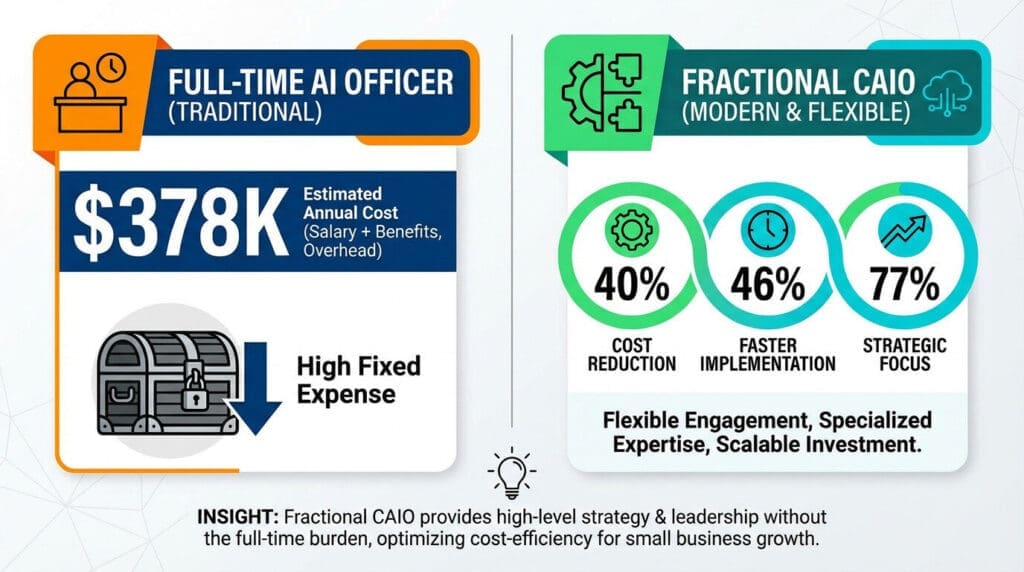
77% of small businesses have adopted AI tools in at least one business function. But adoption without a strategy doesn't create an advantage. It creates digital clutter and wasted money on subscriptions.
The gap isn't in access to AI. Everyone has ChatGPT. The gap is in knowing what to build with it, according to the U.S. Chamber of Commerce.
The Real Cost of DIY AI (It’s Not What You Think)

The Hidden Costs of DIY AI
When you're first exploring AI, the DIY approach feels smart. You're learning. You're experimenting. You're not spending money on consultants.
But there's a hidden tax you're paying: Time you'll never get back.
You spend hours perfecting prompts when a properly designed workflow would handle it in seconds. You test tools for weeks that never integrate with anything meaningful. You stay stuck thinking AI is just for content, missing how it could automate your operations, handle customer service, or surface insights from your data.
Then there are the risks no one talks about:
- Exposing customer data to unvetted tools
- Making decisions based on AI outputs you don't fully understand
- Building on platforms that could change their terms tomorrow
- Creating dependencies on systems you can't maintain
46% of business leaders cite skills gaps as their primary barrier to AI adoption. The issue isn't access to tools. It's knowing how to deploy them strategically, according to research from the U.S. Small Business Administration.
The real cost isn't the hours lost tinkering. It's the growth that passes you by while you're focused on surface-level wins, even though businesses using AI strategically report measurable time savings and productivity gains.
The Shift: From AI User to AI Builder
Here's what changes everything:
Stop thinking of AI as a content tool. Start thinking of it as operational infrastructure.
Instead of just writing better prompts, imagine building systems that run without you:
- That manual process you repeat weekly? Automated with an AI workflow that runs in the background.
- Those customer inquiries clogging your inbox? Handled by a smart system that resolves 80% of questions instantly.
- That data you've been collecting for years? Analyzed by a model that surfaces insights no spreadsheet ever could.
Using AI isn't about prompt engineering. It's really about business redesign.
A strategic AI expert doesn't just help you write better emails. They map your business model, identify high-impact opportunities, and implement systems that are safe, effective, and aligned with your goals. That's why companies with formal AI leadership structures consistently outperform those without.
For most small businesses, that doesn't mean hiring a full-time executive.
It means bringing in the right expertise at the right level.
Enter the Fractional Chief AI Officer
You don't need a full-time AI executive. You need someone who can guide strategy, lead implementation, and deliver measurable results without the overhead of a salaried C-suite hire.
A full-time Chief AI Officer averages $378,000 annually. The fractional model gives you access to that same expertise for a fraction of the investment.
A Fractional Chief AI Officer (CAIO) is a "part-time" executive who acts as a member of your leadership team.
Here's how it works:
Phase 1: Discovery & Strategy
They audit what you're currently doing, identify automation opportunities, and create a roadmap tailored to your business model. They don't hand you a generic playbook. They give what will actually move the needle for your business.
Phase 2: Selection & Integration
They select the right tools for your size and budget, then architect an integrated system and direct implementation so your team or vendor connects everything correctly.
Phase 3: Implementation & Training
They design the systems, train your team, document everything in SOPs, and track performance. Then they optimize based on real results, not vanity metrics.
You get both strategic clarity and hands-on execution.
Companies with senior AI governance see up to 40% higher ROI from their AI investments. Strategic oversight isn't optional. It's what makes AI profitable.
Your Next Move

From AI Dabbler to AI Builder
If you've been experimenting with AI but it hasn't fundamentally changed your business, you're not alone.
The hype is real. But so is the opportunity, as shown in national research on how businesses are actually using AI.
The question isn't whether AI will transform your industry. It's whether you'll be leading that transformation or reacting to it.
Ready to move beyond prompts?
- See if your business is ready for AI
- Learn more about practical AI implementation
Frequently Asked Questions
How are small businesses actually using AI beyond writing emails and social posts?
Most are not. The majority stop at content because it is visible and easy. The businesses getting real leverage are using AI to automate intake, route customer requests, flag exceptions, summarize internal data, and reduce human handoffs. That work happens behind the scenes, which is why it rarely shows up in LinkedIn posts. The value is not louder marketing. The value is fewer manual steps and faster decisions.
What results are small business owners seeing from AI that actually works?
The consistent wins show up in time reclaimed, fewer errors, and better follow through. Owners report shaving hours off weekly processes, reducing response times for customers, and gaining visibility into data they already had but never used. Revenue impact comes later, after the systems are stable. AI delivers results when it is designed around how the business already runs, not bolted on as a side project.
What is holding most small businesses back from using AI effectively?
It is not access. Everyone has access. The real blockers are lack of prioritization, lack of architectural thinking, and fear of making the wrong bet. Owners know AI matters, but they do not know what to build first or how the pieces should connect. That uncertainty leads to stalled pilots, abandoned tools, and subscription sprawl.
Should a small business hire internally, outsource, or get strategic AI leadership?
Hiring internally is expensive and risky unless AI is already a core competency. Outsourcing execution without strategy often leads to disconnected systems. Strategic leadership fills the gap by setting direction, choosing what matters, and guiding execution without adding full time overhead. That is why the fractional model exists. It gives clarity before complexity.
What is the difference between AI that saves time and AI that creates real advantage?
Time saving AI replaces small tasks. Advantage creating AI redesigns how work flows through the business. One helps you move faster. The other helps you operate differently. Competitive advantage comes from systems that are hard to copy, deeply integrated, and aligned to your business model. That does not happen by accident or by prompt experimentation.