
Who Is Brian Gibbs?
Every major technology shift brings the same question. The real question is not “What is this?” or “Should we try it?” It is, “What does this mean for the business?”
I started building websites in 1998, before most companies had a serious online presence. Search engine optimization came next, then paid advertising, platforms, automation, and digital systems.
Twenty-five years later, the technology keeps changing, but the decision does not. My role is to help leaders see what a technology shift actually means for their business, where it creates value, where it creates risk, and what deserves attention first.
Why I Do This
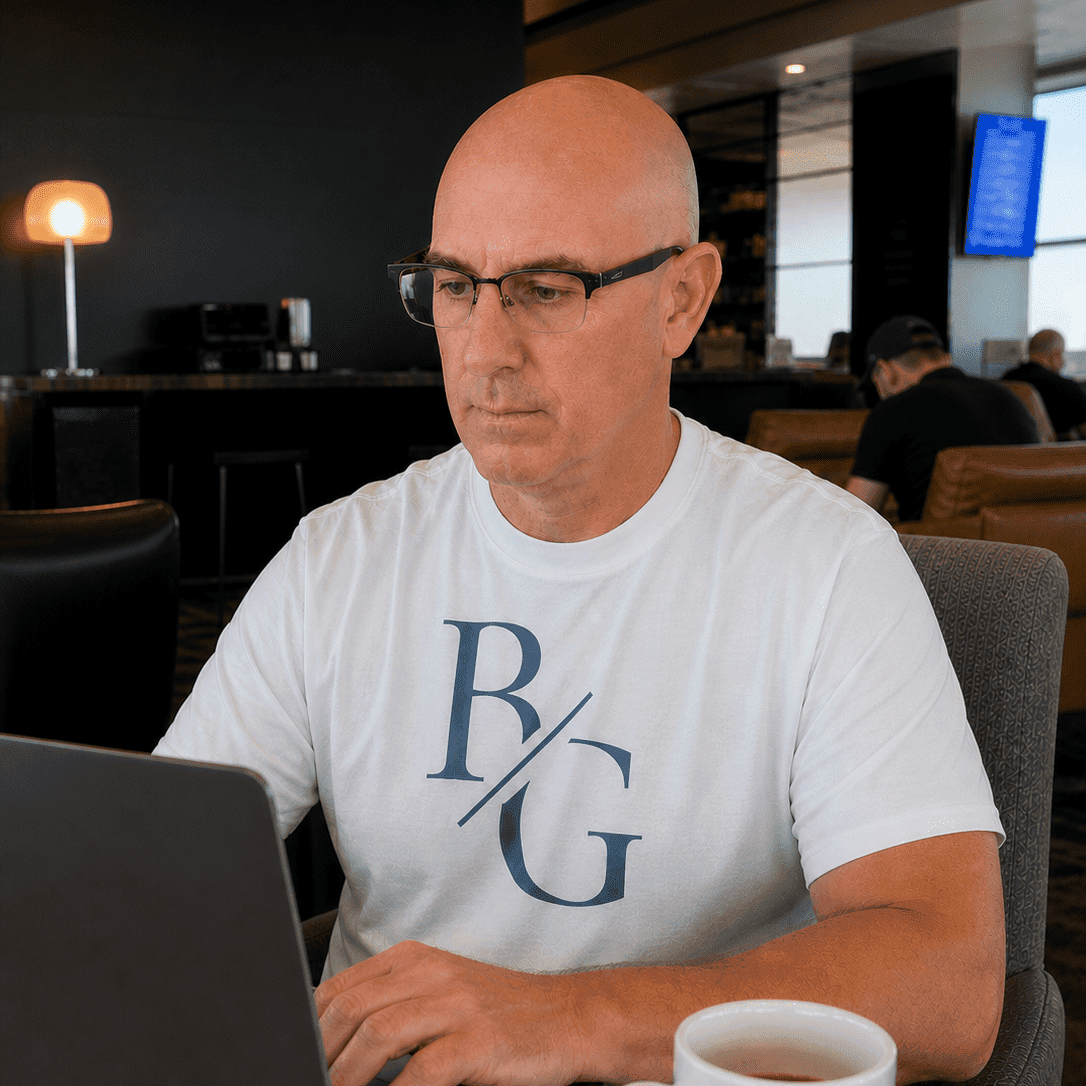
On December 23, 2022, flights were canceled across the country. What started as a routine layover in the Centurion Lounge in Las Vegas turned into a scramble for one of the last seats back to San Antonio. Back home that night, YouTube served up something called ChatGPT.
Eight hours later, one thing was clear. In twenty-five years of watching technology reshape business, I had never seen anything move this fast.
Business leaders were about to face a decision they could not hand off to a tool, a vendor, or a junior employee. They needed a way to decide where AI belonged, where it didn't, and what should happen first.
That is the work I do now.
Sound familiar?
I help you make a clear AI decision you can stand behind.
My dad ran a roofing company for thirty years. He knew his craft, knew his customers by name, and understood that every decision carried weight. That is the kind of business owner I work with today.
The difference is that he never had to decide whether to trust a machine with customer relationships, pricing, operations, or reputation. You do. That means the decision deserves more than a tool demo or a quick recommendation.
You come in with a business that already works and an AI decision that needs structure. I ask the questions your team may be too close to see. I look at where the opportunity is, where the risk sits, and what is actually worth doing.
You leave with a written strategy that tells you what to do, what to ignore, and why.
The decision is the product.
The value is not in giving you more possibilities. It is in helping you make one clear decision and understand why it is the right one.
I help you cut what does not matter.
If an idea, tool, or project does not support the business decision, I take it off the table so you can focus on what does.
The scope stays tight.
I narrow the work until the decision is clear enough to act on. That keeps the strategy useful and keeps the business from getting buried in options.
The decision has to hold up.
If you cannot explain the reasoning to your team, defend it when someone challenges it, and still believe it is the right call, the strategy is not finished.
The Lesson From the 1992 Olympic Trials
At the 1992 Olympic Trials, the wind picked up and I had a decision to make. I chose smaller gear because it felt safer. In that moment, fear overruled what years of training had already taught me.
I still think about that decision because I see the same thing happen in business. When the stakes go up, even experienced leaders can reach for the option that feels safest instead of the one the situation actually calls for.
That hesitation can be expensive with AI. The cost rarely shows up all at once. It shows up in delayed decisions, scattered experiments, and months spent circling a choice that still needs to be made.
Sometimes the most useful thing you can get is an outside perspective that helps you see what the hesitation is already costing you.
If AI does not belong somewhere in your business, I will tell you. I would rather give you the answer that protects the business than the answer that is easiest to hear.
A clear decision made at the right time is worth more than a perfect decision that comes too late. Knowing what to leave alone matters just as much as knowing what to pursue.
You work with me directly from beginning to end. I do not hand the work off to junior staff. If I recommend a direction, I am prepared to explain it, defend it, and stand behind it.