
The Complete Guide to AI Strategy for San Antonio Businesses

A San Antonio business owner and AI strategy advisor review workflow tasks and growth numbers together.
You Built Something Real. Now AI Is Changing the Rules.
You have been running your business for years. You know your customers by name. You have survived slow seasons, staffing problems, and economic swings that pushed competitors out. You are still here because you are good at what you do.
Now AI is everywhere. Your competitors are talking about it. Your vendors are selling it. Your employees are using it on their phones. And you are trying to figure out whether this is the real thing or just another wave of hype.
Here is the honest answer: getting AI strategy right is one of the most important things a San Antonio business owner can do right now. AI is real, it is moving fast, and the businesses that build a clear plan now are going to have a significant edge over the ones that wait.
The Dallas Federal Reserve tracked AI adoption among Texas businesses from 2018 to 2025. Usage jumped from 5.4% to 59.1% in seven years. That is not a trend. That is a shift.

AI adoption among Texas businesses has grown more than 10 times in seven years, reaching 59.1% in 2025 according to the Dallas Fed.
But adoption alone does not mean results. Most businesses that jump into AI without a strategy end up with expensive tools that nobody uses and processes that are more complicated than before. That is what this guide is designed to help you avoid.
What an AI Strategy Advisor Actually Does for Your Business
Before we get into frameworks and tactics, it helps to understand what working with an AI strategy advisor actually looks like in the context of AI strategy San Antonio business owners need most.
An AI strategy advisor does not sell you software. That is the job of a software vendor. An advisor looks at how your business actually operates, finds the places where AI can deliver the most value, and builds a plan you can execute without disrupting what is already working.
In practice, that means three things.
First, mapping where AI fits your specific operation. Every business is different. What works for a medical practice in Stone Oak does not automatically work for a plumbing company in Helotes. The starting point is always your business, your workflows, and your customers, not a generic list of AI tools.
Second, prioritizing by ROI rather than hype. There are hundreds of AI tools available right now. Most of them are not right for your business at this stage. A good strategy advisor helps you ignore the noise and focus on the two or three changes that will actually move the needle in the next 90 days.
Third, giving you a plan you can execute. Strategy without execution is just a document. The goal is a clear sequence of steps, assigned to real people inside your business, with measurable outcomes at each stage.
That is the work. Good AI strategy is less exciting than a software demo and more valuable than anything a vendor will ever show you.
Why San Antonio Is Different from the National AI Conversation
Most AI advice you read online comes from people who have never run a service business in a relationship-driven market. San Antonio is not Silicon Valley. Your customers expect to know who they are dealing with. Your reputation is built on trust, not just speed.
That is actually an advantage.
In markets where everyone has already adopted basic AI, the tool itself does not create an edge. In San Antonio, most small and mid-size businesses are still running manual processes for scheduling, customer communication, and reporting. That means the businesses that invest in AI strategy San Antonio competitors have not figured out yet are not just keeping up. They are pulling ahead.

AI strategy is showing up across San Antonio industries including HVAC, healthcare, logistics, and retail.
A plumber in Northwest San Antonio does not need enterprise AI. He needs better emergency call handling, consistent customer follow-up, and a scheduling system that does not require him to be on his phone at 10 PM. Those are solvable problems with straightforward tools, as long as someone helps him pick the right ones and set them up correctly.
That is the local opportunity. Targeted, practical AI that fits how San Antonio businesses actually operate.
AI Strategy San Antonio Businesses Are Using Right Now
Here is what strategic AI adoption looks like across the industries that make up most of San Antonio’s small business economy.
HVAC and home services. A San Antonio HVAC company built an AI strategy San Antonio service businesses have started copying. They used AI to handle after-hours emergency call routing and technician dispatch. The system pulls customer history, checks technician availability, and sends the customer an estimated arrival time automatically. The owner stopped missing calls during evenings and weekends. Response time dropped by 40 minutes on average, and customer reviews improved significantly within the first quarter.
Healthcare and medical practices. A local dental practice added AI-assisted appointment scheduling and insurance verification. Front desk staff were spending nearly three hours a day on phone tag for confirmations and insurance questions. That dropped to under an hour. The practice was able to see four additional patients per week with the same staffing level.
Professional services including law, accounting, and insurance. An insurance agency in San Antonio used AI to automate renewal reminders and policy update confirmations. Agents had been doing this manually, which meant it only happened when someone remembered. With the automation in place, every client got a timely reminder. Renewal rates went up 12% in the first six months.
Construction and trades. A mid-size commercial contractor used AI to organize project documentation and generate status reports for clients. Project managers were spending two to three hours a week pulling information together for client updates. The AI handles that automatically now. The managers use those hours for site visits and problem-solving instead.
Retail and restaurants. A San Antonio restaurant group added AI-powered inventory alerts that flag when items are running low based on sales velocity. They used to run out of high-margin items on busy weekends. That problem is essentially gone. Food waste also dropped because ordering is now based on real data instead of guesswork.
None of these businesses replaced their people or overhauled their systems. They added a layer of intelligence to what was already working.
The COMPASS FrameworkSM
The biggest reason AI projects fail is not the technology. It is the lack of a clear process for deciding what to do, in what order, and how to measure whether it is working. Good AI strategy San Antonio businesses can sustain long-term starts with this framework.
The COMPASS FrameworkSM is the approach I use with every San Antonio business I work with. It is designed to get you results within 90 days without breaking what already works.
COMPASS stands for:
- Capture : Document how your business actually works today, not how you think it works
- Observe : Find where time and money are leaking out of your workflows
- Map : Build a clear route from where you are to where you want to be
- Prioritize : Focus on the changes that deliver the biggest results first
- Analyze : Make decisions based on real data, not guesswork
- Streamline : Simplify, automate, and remove friction from your team’s daily work
- Sustain : Keep the system working and improving as your business grows
Each step builds on the one before it. You do not skip ahead.
C : Capture: Document What Actually Happens
The first step is mapping your current workflows as they actually exist. Not the version in your employee handbook. The real version, including the workarounds, the informal processes, and the steps that only happen because one person has been doing them for eight years.
Walk through a complete work cycle with your staff. Time each step. Note where information changes hands, gets duplicated, or disappears. Most business owners discover things during this step that surprise them.
What to document: every step in your most common workflows, who handles each step, how long it takes, and where errors or delays typically occur.
O : Observe: Find the Leaks
Once you have your workflows documented, look for patterns. Where does work pile up? Which steps require the most back-and-forth? Where do errors happen most often?
Look for tasks that involve entering the same information in more than one place. Look for processes that stop because someone is waiting on a response. Look for decisions that should be simple but somehow take an hour.
These are your automation candidates. The goal in this step is not to fix anything yet. It is to see clearly.
M : Map: Build Your Route
Mapping turns what you observed into a prioritized plan. The key principle here is sequencing. Some improvements only become possible after others are in place. Getting the order right saves you from doing the same work twice.
For most businesses, the map starts with one high-impact, low-risk process. Something that will show clear results in the first 30 days and build confidence for the next step.
P : Prioritize: Focus on What Moves the Needle
This is where most businesses go wrong. They try to fix everything at once. Or they focus on the most impressive-looking technology instead of the highest-value problem.
Rank your potential improvements by two factors: how much impact they will have on your business, and how much effort and risk they require to implement. Start in the top-left corner of that matrix. High impact, low effort. Work your way from there.
A : Analyze: Use Real Data
Before you change anything, establish a baseline. How long does the current process take? How many errors does it produce? What does it cost in staff time each week?
You cannot measure improvement without a starting point. This step protects you from thinking something worked when it did not, and from missing real results because you were not tracking the right things.
S : Streamline: Simplify and Automate
Now you implement. But with a clear principle: automate the repetitive and rule-based parts of your work. Preserve human involvement everywhere that judgment, relationships, and context matter.
The goal is not maximum automation. It is optimal automation. The right amount of AI in the right places, so your team spends their time on the work that actually requires them.
S : Sustain: Keep It Working
AI is not a one-time project. It is an ongoing capability. Plan for regular reviews, staff training updates, and incremental improvements as your business grows and your needs change.
Businesses that treat AI as a completed project six months after launch consistently underperform compared to businesses that treat it as an evolving system. That is why a good AI strategy San Antonio businesses sustain over time always includes a plan for ongoing review.
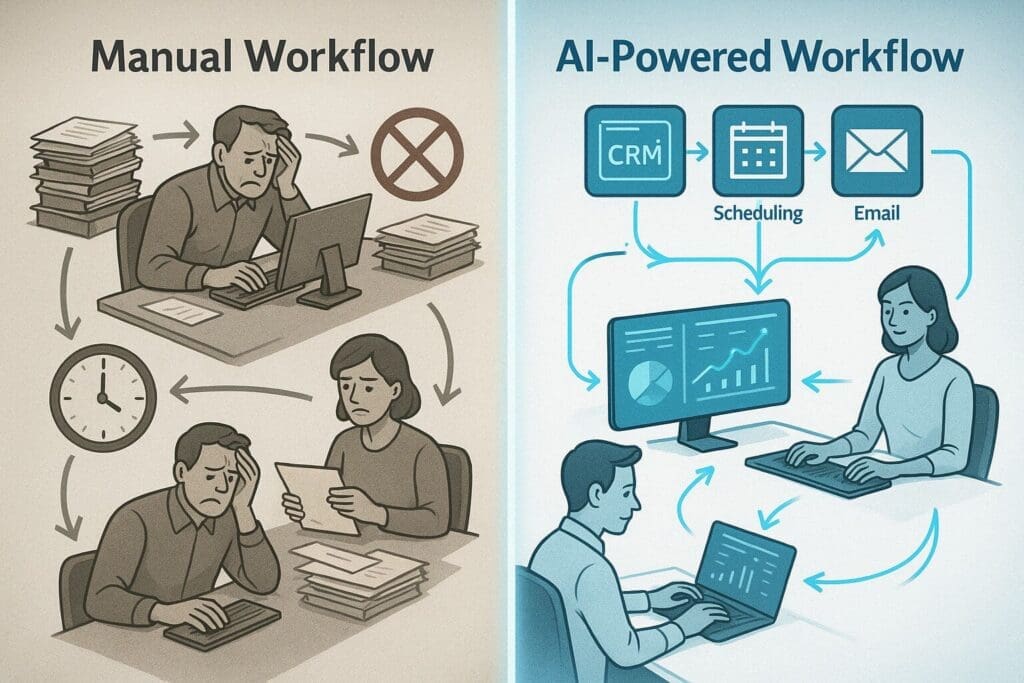
The difference between a manual workflow and an AI-supported workflow is not just speed. It is the amount of your team’s attention that gets freed up for real work.
Before and After: What AI Strategy San Antonio Businesses Build Actually Changes
Here is how the same business looks before and after building a real AI strategy.
| Area | Without an AI strategy | With an AI strategy |
|---|---|---|
| Decision-making | Based on intuition and whatever data is easy to find | Based on current data pulled automatically from your systems |
| Time spent on admin | 8 to 14 hours per week for the owner | 2 to 4 hours per week after the first 90 days |
| Customer response speed | Depends on who is available and when | Routine responses happen immediately, complex ones go to the right person |
| Technology spending | Multiple tools with overlapping functions and unclear ROI | Fewer tools, each with a defined purpose and measurable outcome |
| Team clarity | Processes live in people’s heads and change based on who is working | Documented workflows that produce consistent results regardless of who handles them |
The 5 Most Expensive AI Strategy San Antonio Mistakes to Avoid
After working with local businesses on AI strategy for years, the same five mistakes show up in almost every failed project.
Mistake 1: Choosing technology before defining the problem
This is the most common and most expensive mistake. A vendor demos impressive software. You sign up. Six months later the system sits mostly unused because it was never really matched to how your business works.
The fix is simple but requires discipline. Define the three specific outcomes you need AI to deliver before you look at a single tool. Then evaluate tools based on how well they fit your actual workflows, not how good the demo looks.
Mistake 2: Skipping the change management work
Your staff will not automatically embrace AI tools. They need to understand why the change is happening, how it makes their jobs easier rather than threatening them, and what is expected of them during the transition.
Businesses that skip this step see adoption rates collapse after the first few weeks. The system becomes shelfware, and the owner concludes that AI does not work for their business when the real problem was the rollout.

Getting your team involved in the AI strategy process from the beginning makes adoption significantly smoother.
Mistake 3: Expecting results too fast
Most AI implementations show early signs of improvement in the first four to six weeks. But full results take longer. The system needs time to learn your patterns. Your team needs time to build new habits. The workflow needs refinement based on real usage.
Business owners who expect dramatic results in the first two weeks often abandon projects that would have delivered strong returns by month four. Set realistic milestones. Measure consistently. Give the system time to mature.
Mistake 4: Starting with messy data
AI tools that depend on your historical business data, and most useful ones do, will produce garbage output if your data is disorganized. Customer records in three different formats. Incomplete order histories. Inconsistent naming conventions.
A data audit before implementation is not optional. It is the difference between an AI that helps you and an AI that confidently gives you wrong answers.
Mistake 5: Treating it as a one-time project
AI is a capability, not a task. Businesses that get the most value from AI are the ones that build ongoing review and optimization into their operations. Quarterly check-ins. Regular training updates. Planned capability expansions as the business grows.
The businesses that treat the initial setup as the finish line consistently underperform. Good AI strategy is an ongoing process, not a project with an end date.
How to Know Whether Your AI Strategy San Antonio Investment Is Actually Working
The question every smart business owner asks before investing is: how will I know if this is actually working? Getting AI strategy San Antonio owners can trust means being able to answer that question with real numbers, not gut feelings.
The answer is measurement. But measuring the right things.
Most AI vendors will show you usage metrics. How many queries the system handled. How many hours of processing time it completed. Those numbers tell you the system is running. They do not tell you whether your business is better.
Here is what to measure instead.
Time-based efficiency. Pick one process and time it before and after. Appointment scheduling. Email follow-up. Report generation. Set a baseline before you change anything. Measure again at 30 days and 90 days.
Error rates. If the process you automated was prone to errors, track error frequency before and after. A reduction in errors often has a direct dollar value attached to it through rework time, refunds, or lost customers.
Capacity. Are you handling more volume with the same team? This is one of the clearest signals that AI is working. More clients, more orders, or more appointments without adding headcount.
Customer satisfaction. Are customers commenting on faster responses or more consistent communication? Are review scores trending up? This matters especially for San Antonio businesses where reputation is everything.
Owner time. How many hours a week are you spending on tasks that do not require your judgment? If that number is going down, AI is doing its job.
For a full breakdown of how to calculate the dollar value of reclaimed time, see San Antonio Business AI Solutions: Save 10 Hours Weekly.

Measuring the right outcomes, not just system activity, is what separates AI projects that deliver results from ones that just look busy.
Your First 90 Days of AI Strategy San Antonio: What to Do and When
Here is a practical AI strategy sequence for getting started without overwhelming your team or your budget.
Days 1 through 30: Foundation work. Document your three biggest time drains. Pick one to focus on first. Establish a baseline measurement for that process. Research two or three tools that address it specifically. Do not sign any contracts yet.
Days 31 through 60: Pilot implementation. Choose one tool. Implement it for the one process you identified. Assign one person inside your business to own it. Train your team. Run it alongside your current process for the first two weeks so you have a fallback if needed.
Days 61 through 90: Measurement and expansion. Compare your baseline measurements to current performance. If the numbers support it, expand the automation to a second process. If they do not, diagnose the gap before moving forward.
This sequence keeps risk low and gives you real data to make decisions from. You are not betting the business on a six-figure AI overhaul. You are running a disciplined pilot that either proves its value or tells you exactly what to fix.
For a step-by-step look at specific automation tasks you can start with today, see AI Automation Tasks San Antonio Businesses Can Do Today. Building a solid AI strategy San Antonio businesses can actually execute does not require a big budget or a technical team. It requires the right sequence and clear measurements at each step.

A clear implementation roadmap is the difference between AI that delivers results and AI that collects dust.
Frequently Asked Questions About AI Strategy San Antonio Business Owners Ask Most
What does an AI strategy advisor do for a small business?
An AI strategy advisor helps you figure out where AI fits your specific business, which problems are worth solving first, and how to implement changes without disrupting what is already working. The job is not to sell you software. It is to help you make smart decisions about technology so you get real results instead of expensive tools that nobody uses.
How is an AI strategy advisor different from an AI consultant?
A consultant typically comes in, completes a defined project, and leaves. An advisor stays at the table with you through the decision-making process, the implementation, and the adjustments that come after. The relationship is built around your ongoing business goals, not a one-time deliverable. For most small businesses, that ongoing accountability is what makes the difference between a successful AI rollout and a failed one.
How much does AI strategy cost for a small business in San Antonio?
It depends on the scope of the work. A focused AI strategy session that maps your opportunities and builds a 90-day plan costs significantly less than a full implementation engagement. Most small businesses spend between $5,000 and $25,000 for strategy and initial implementation support. The tools themselves vary widely, from free to a few hundred dollars a month for most small business use cases. The right starting point is a conversation about your specific situation before any numbers are committed.
How long before a small business sees results from AI?
Most businesses see meaningful time savings within the first 30 days of a well-implemented automation. Bigger business results, like increased capacity, improved customer retention, or reduced staffing costs, typically show up between 60 and 120 days. Full ROI on the investment usually takes 6 to 12 months. The timeline depends heavily on starting with the right process and building the workflow correctly the first time.
Do I need technical skills to work with an AI strategy advisor?
No. The technical work is the advisor’s job. Your job is to know your business, be willing to describe how your workflows actually operate, and be open to changing a few processes. Most of the AI tools that work well for San Antonio small businesses are designed to be used by people with no technical background. If a tool requires a developer to maintain it, it is probably the wrong tool for your situation.