

What an AI Strategy Advisor Does for CEOs and Owners Who Are Unsure About AI
An AI strategy advisor works with a CEO or owner to figure out what AI means for their company, where it could help, and what to do first. The advisor looks at how the business actually runs, finds the few places where AI can save time or make money, and gives leadership a plain-language plan they can act on. I do this work for established companies across many industries, and the starting point is often a simple question from the owner about what, exactly, the company is supposed to do with AI.
If AI Feels Confusing, That Makes Sense
Most owners and CEOs did not go looking for AI, yet it keeps showing up in their week. A vendor mentions it in every pitch. A board member asks about it. A competitor posts about it on LinkedIn. Software the team already pays for suddenly has an AI button that nobody asked for.
The result is a lot of noise and very little direction. Many leaders feel like they are supposed to have an opinion on something they have never had time to learn. They sense that waiting too long could cost them, and they also worry that moving too fast could break something that works today.
That feeling is common, and it is a reasonable place to start. Running a company is a full-time job. Learning a new technology from scratch on top of it is a second one. An AI strategy advisor exists so the owner does not have to take on that second job alone.
What an AI Strategy Advisor Actually Does
The simplest way to describe the role is translator and guide. The advisor learns the business first, then explains what AI could do inside it in words the leadership team already uses.
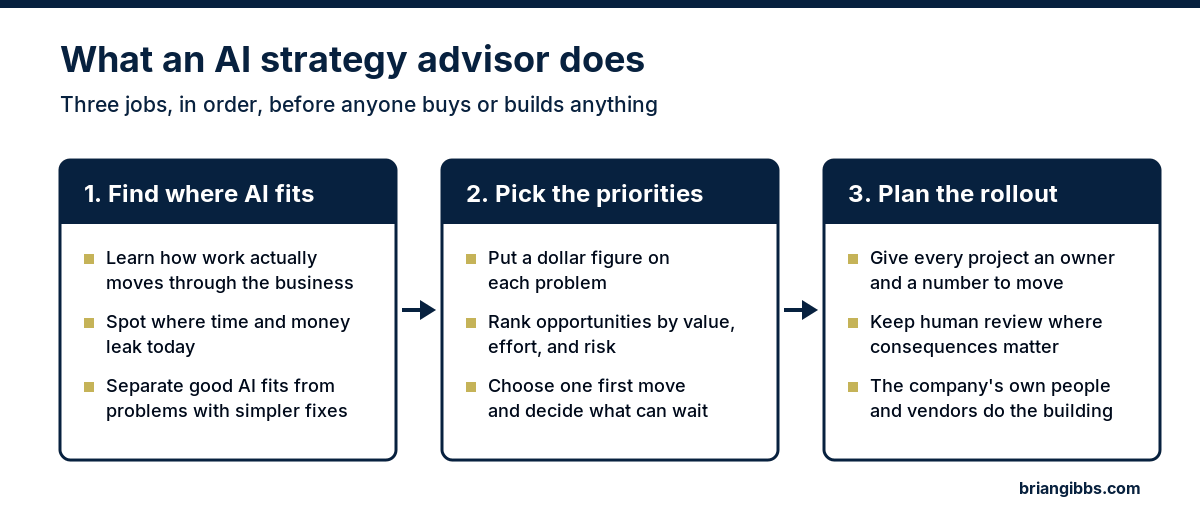
In practice, I work with leaders on a short list of practical questions:
- Where does time and money leak today? Every company has work that eats hours, slows customers down, or depends on one overworked person.
- Could AI help with any of it? Some problems are a good fit for AI. Others need a process fix, a new hire, or nothing at all.
- What goes first? Opportunities get ranked by value, effort, and risk, so the first move is the one most likely to pay off.
- What has to stay human? Customer relationships, judgment calls, and anything with real consequences keep a person in charge.
- How will anyone know it worked? Each project gets an owner, human review, and a number it is supposed to move.
I put it in one line: strategy decides where AI belongs. Once a problem is clear and has a dollar figure attached, the AI question gets much easier to answer.
What This Looks Like in Different Industries
The questions stay the same from one company to the next. The answers change a lot. A few examples show how differently AI can show up depending on the business.
A medical or wellness practice might lose hours every week to appointment reminders, intake paperwork, and insurance follow-up. A distribution company might have sales reps retyping orders from emails into the system by hand. A professional services firm might spend the first two days of every month building the same client reports. A manufacturer might have years of know-how locked in the heads of two senior people who are getting close to retirement.
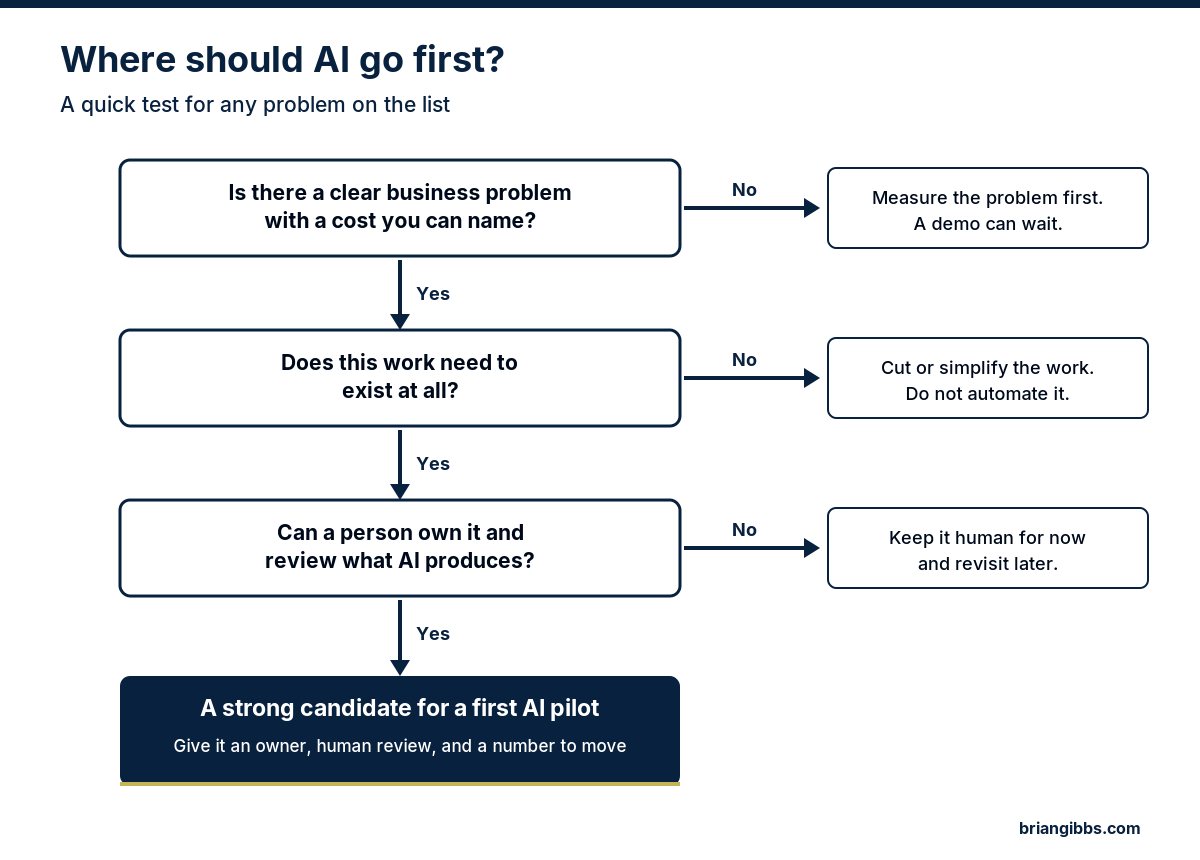
Each of those is a real business problem with a cost attached. In some cases AI is a strong fit. In others, a simpler fix does the job. An advisor works with leadership to tell the difference before anyone signs a contract.
Here is one real example. A service company running six trucks across 47 ZIP codes rethought how it routed its crews. Fuel costs went down and the crews fit more calls into each day. I tell the full story in my book From Overwhelmed to Optimized. The lesson carries over to almost any industry. Start with a problem the owner already feels, put a number on it, and then decide whether AI belongs there.
How an Advisor Differs From a Software Vendor
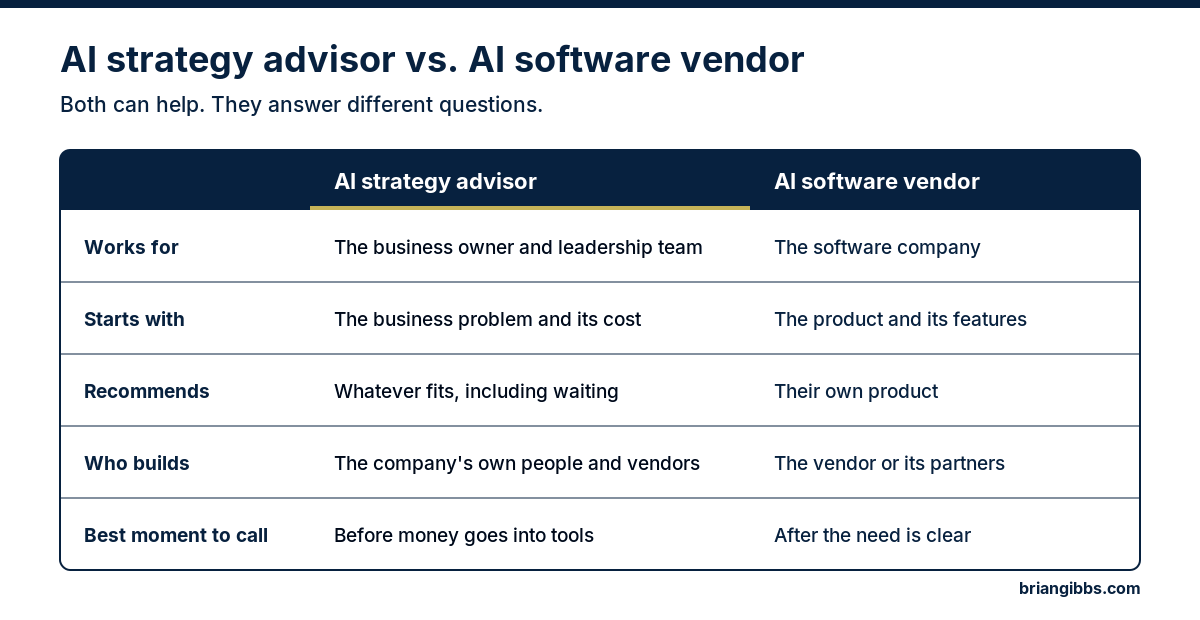
Software vendors are useful. They know their product well, and a good one can solve a real problem. Their job is to sell their own tool, though, and a demo can only show what that software is capable of doing. Deciding what a particular business needs is a separate question.
An advisor sits on the owner’s side of the table. I stay tool-agnostic, which means I do not sell or resell software and have no reason to favor one product over another. Depending on the situation, the best advice might be to buy a specific tool, to describe what a tool needs to do and let the team compare options, or to wait until the business is ready.
The advisor also stays out of the building work. I advise, and the company’s own people and vendors do any building. That keeps the advice honest, because the recommendation has nothing to do with who gets paid to build it.
Signs It Is Time to Talk to an Advisor
There is no single right moment, though a few situations come up again and again with the owners I talk to:
- A software salesperson is pushing an AI product and the leadership team has no way to judge whether it fits.
- The company already pays for several tools with AI features and nobody can say what they are producing.
- Someone on the team tried an AI project that stalled, and now people are skeptical.
- A board member, partner, or lender has asked what the plan for AI is.
- The owner simply knows AI matters and wants a clear, low-risk place to start.
Any one of those is a good reason to get an outside view before spending real money.
Who I Am
I am the founder and principal advisor of Brian Gibbs & Associates, an AI strategy advisory firm. I have been doing business online since 1998, starting with websites and moving through search, advertising, and automation. I began working with AI in December 2022, a few weeks after ChatGPT launched, and shifted my work toward AI strategy after owner after owner at networking events told me they needed to understand it.
I am the author of three books on AI strategy: The Customers You’re Already Missing, From Overwhelmed to Optimized, and What NOT to Automate. More of my background is on the About Brian Gibbs page.
A Clear First Step
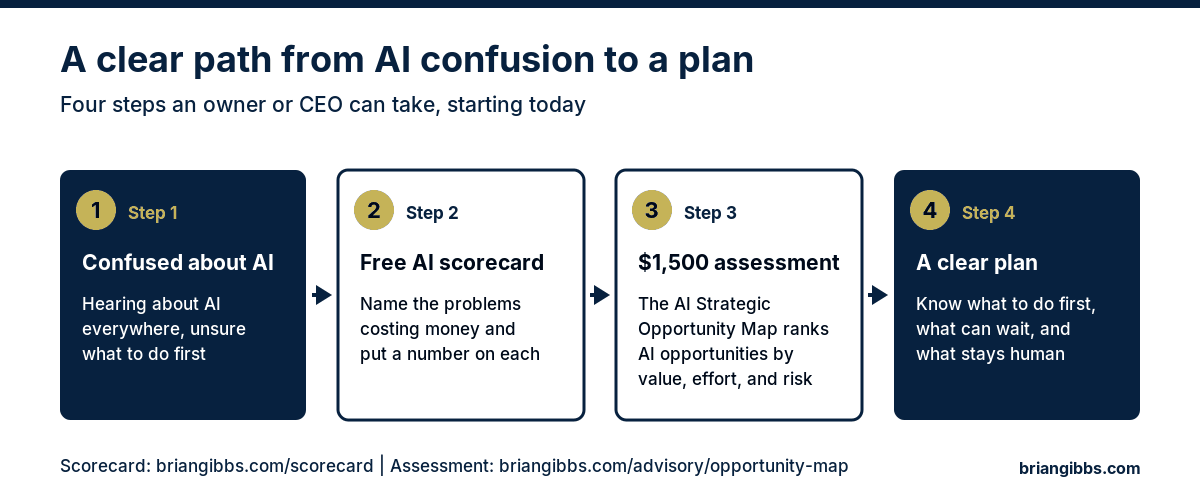
The easiest way to start costs nothing. The free AI scorecard walks an owner through the problems costing the company money, asks for a rough dollar figure on each one, and then shows where AI might earn a place. It runs in the browser, takes a few minutes, and ends with a downloadable PDF of the top three problems.
The next step is the AI Strategic Opportunity Map, a $1,500 written assessment of the company. The team fills out a structured questionnaire about how the business runs. Brian Gibbs & Associates then prepares a written assessment with AI opportunities ranked by value, effort, and risk, and I personally review it before it goes out. There is no meeting required, and the assessment arrives within five business days after I receive the completed questionnaire.
For leadership teams that want me working with them directly, the advisory page explains the deeper engagements.
Start with the free scorecard, then get your AI assessment.
Frequently Asked Questions
What does an AI strategy advisor do?
An AI strategy advisor works with a company’s leaders to decide where AI belongs in their business and what to do first. The advisor studies how work moves through the company, finds the problems that cost the most time or money, ranks AI opportunities by value, effort, and risk, and gives leadership a plain-language plan. The advisor recommends and guides, while the company’s own team or vendors do any building.
Does a CEO need to understand AI before working with an advisor?
No. Many owners and CEOs start out confused about AI, and that is normal. The advisor’s job is to learn the business first and explain AI options in everyday business language, so leaders can make decisions without becoming technical experts.
How is an AI strategy advisor different from an AI software vendor?
A software vendor sells a specific product and shows what that product can do. An AI strategy advisor works for the business owner, stays independent of any tool, and starts with the company’s problems before looking at software. I am tool-agnostic and do not sell software, so my recommendations follow the business need.
What is the first step to getting an AI strategy?
Start by naming the business problems that cost the most and putting a rough dollar figure on each one. I offer a free AI scorecard at briangibbs.com/scorecard for this. The next step is the $1,500 AI Strategic Opportunity Map, a written assessment that ranks a company’s AI opportunities by value, effort, and risk and is delivered within five business days of the completed questionnaire.
What kinds of companies do I work with?
I work with CEOs, owners, and leadership teams of established companies, and the work is not limited to one industry. Examples from my work and writing include field services, wellness, manufacturing, agriculture, and an art gallery. The common thread is a leader who knows AI matters and wants a clear, practical place to start.