

AI Roadmap for Business: 7 Steps to Decide Where AI Fits First
When I was racing bikes, my specialty was sprinting. Sprinting is very tactical and strategic, and that’s how I’ve always approached things in my life. I was taught how to play chess when I was 7 years old. I wasn’t great, and I never entered any contests, but I beat a lot of the adults, and even at that age I could tell they weren’t trying to let me win.
That’s how I approach AI and working with clients. I start with two questions. Where does this actually fit? Is it a strategic move, or is it simply a tactic for a one-off solution? Most of the CEOs and owners I talk with are being pushed toward one tool after another with no plan connecting them. An AI roadmap answers both questions before you spend.
The short answer
An AI roadmap for business is a one-page plan that names the result you want, the two or three places AI will help first, who owns each one, and the rule for when to stop. You build it by measuring where your time goes, asking your team where work gets stuck, filtering tools hard, and running one 90-day pilot before you spend more.
Why most AI roadmaps stall
The noise makes it hard to know what belongs in your business, and the results at large companies are sobering. In McKinsey’s 2026 survey, 37 percent of respondents attribute at least some impact on earnings before interest and taxes to AI, about the same share as the year before, and only about 6 percent qualify as high performers. Gartner surveyed 2,002 chief information officers and technology executives and found that only 13 percent say their organization has realized significant or transformational value from AI, and the likelihood of any single use case succeeding is still about one in five.
Most guides on how to build an AI roadmap were written for those same large companies. They tell you to appoint an AI lead, set up an AI lab, form a steering group, and run a program where the first wave alone takes roughly nine months. If your leadership team fits around one table, your AI roadmap for companies like yours should be a plan you can draft in an afternoon and start acting on next week. The seven steps below are that plan.
The 7-step AI roadmap
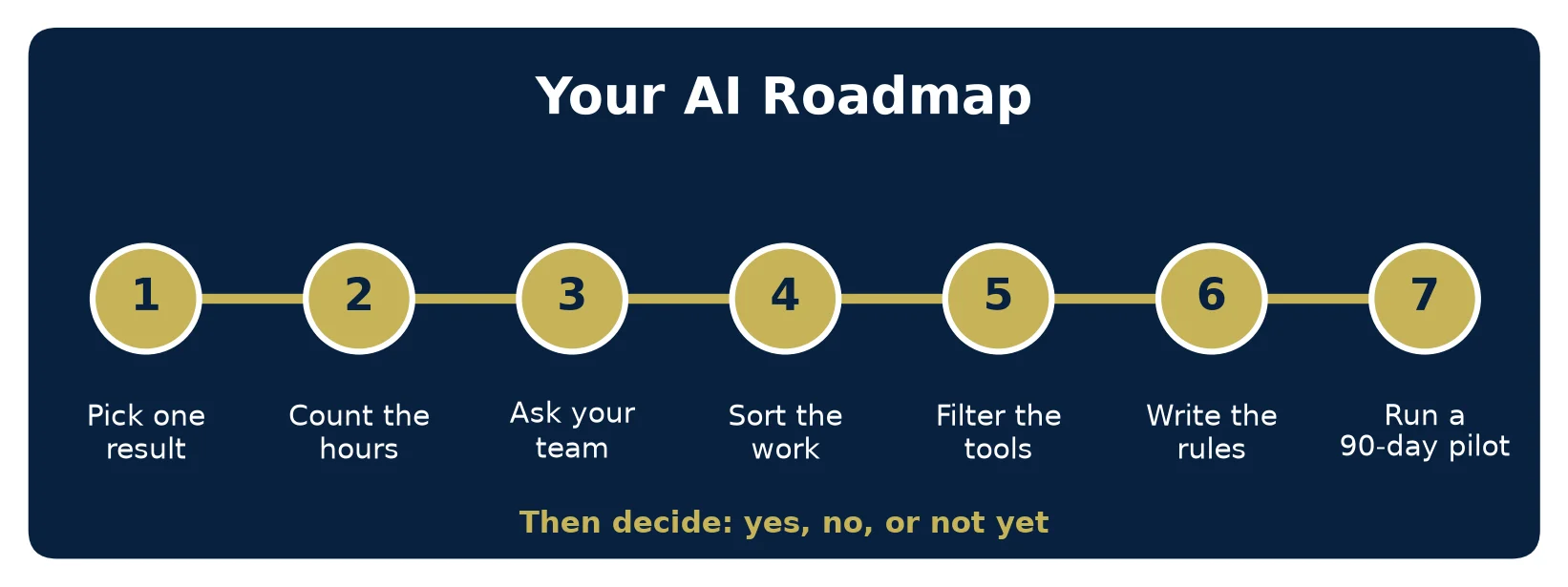
Step 1: Pick one business result and write the real numbers down
Before AI enters the conversation, name the result you want to move. Think faster quotes for a distributor, fewer missed calls for a dental practice, or a quicker month-end close for an accounting firm. Then pull today’s numbers and write them down in pen. Almost every owner who does this finds a surprise, and that surprise is often where the roadmap starts.
Step 2: Count the hours you are losing
Work out your effective hourly rate by dividing your company’s revenue by the hours you work. Then estimate how many hours a week you spend on tasks that don’t need you specifically. Multiply the two. I call this the Time Reclamation Calculation, and the number it produces is the upper limit of what the right AI work is worth to you in recovered capacity.
Step 3: Ask your team where the friction is
Your people know where work gets stuck. Ask them which tasks take too long, which parts of the job feel least meaningful, and what they wish they had more time for. A service manager at a heating and air company will point to dispatch. A paralegal will point to document review. I call this the Involvement Principle. It produces better ideas, and the skeptics who help shape the plan usually become the people who make it work.
Step 4: Sort every idea into AI, automation, software, or people
Four different things get called AI. AI does judgment-shaped work such as drafting, summarizing, and spotting patterns. Automation does rule-shaped work: when a form comes in, send the confirmation. Ordinary software carries and stores the work. People decide what is true, what is kind, and what goes out under your name. Once your list is sorted, many “AI projects” turn out to be a simple automation or a setting in software you already own. Give each idea one answer: yes, no, or not yet.
Step 5: Filter tools before you compare them
I use what I call the Elimination Rule. Before you look at features, cut every option that fails one of four filters. It has to connect to the systems you already use, its cost has to be in proportion to the likely return, you have to be able to run it without technical support you don’t have, and it has to offer a trial or a low-commitment way to start. Most of the market drops away, leaving two or three options worth a serious look.
Step 6: Write the rules before anything goes live
For each tool, answer six questions in writing: what data it touches, how that data is stored and for how long, how you override it when it fails, who checks its output, which regulations apply in your industry, and what happens when a customer problem traces back to the tool. Add one standing rule that customer names and personal details never go into a public chat tool. Then write your stop rule. Gartner found that organizations with guidelines for when a pilot should not move to production are 2.3 times more likely to be in its top-performing group, yet only 31 percent of chief information officers have them.
Step 7: Run one 90-day pilot, then decide
Split the pilot into three phases. Use weeks 1 to 4 for the baseline, setup, and team training. Use weeks 5 to 8 for live use with one named owner. Use weeks 9 to 12 to tune the tool and measure it against your Step 1 numbers. Expect a dip early on while people learn, and judge the result at the end against the baseline. Then make the call to scale it, fix it, or stop it, and move to the next result on your list.
A one-page AI roadmap template and AI strategy example
Your AI strategy plan and your roadmap fit on one page, and that page doubles as a simple AI strategy framework for business leaders who want something short enough to use. Here is the AI strategy roadmap template I would use, filled in as an AI roadmap example for a hypothetical regional distributor.
| Field | What to write | Example: regional distributor |
|---|---|---|
| Business result | One outcome you can measure | Same-day quotes on standard orders |
| Baseline | Today’s real number | Quotes take most of a week |
| Hours at stake | Weekly hours times your effective hourly rate | Two inside sales reps’ mornings, every day |
| Team input | Where people say work gets stuck | Reps retype part numbers from emailed requests |
| Sort | AI, automation, software, or people | AI drafts the quote, software pulls pricing, a rep approves every quote |
| Tool shortlist | Options that pass all four filters | Two tools that connect to the current order system |
| Rules | Six written answers plus a stop rule | Stop if reps are still rewriting most drafts by week 8 |
| Owner and review | One name and a 90-day date | Sales manager, review at day 90 |
| Decision | Yes, no, or not yet | Made at the day-90 review |
Checklist: is your AI roadmap ready?
- One business result written down with today’s real number
- Weekly hours at stake calculated at your effective hourly rate
- Team asked where work gets stuck
- Every idea sorted into AI, automation, software, or people
- Tool shortlist passed all four filters
- Six rules questions answered in writing
- Stop rule written before the pilot starts
- One owner named for a 90-day pilot
- Review date on the calendar
Frequently asked questions
How do I create an AI roadmap?
Pick one measurable business result, write down today’s numbers, and count the hours at stake. Ask your team where work gets stuck, sort each idea into AI, automation, software, or people, and filter tools before you compare them. Write your rules and a stop rule, then run one 90-day pilot with a named owner and decide yes, no, or not yet.
Where should I start with AI?
Take the free AI scorecard at briangibbs.com/scorecard/ first to see where AI may help your business and where it needs a closer look. Then start with the problem that costs you the most time each week and has a number you can measure.
What is the difference between an AI strategy and an AI roadmap?
An AI strategy explains why you are using AI and where it belongs in your business. An AI roadmap lays out what happens first, who owns it, and when you will review it. You need both, and they fit on one page.
What should an AI strategy template include?
A good AI strategy document includes the business result, the baseline number, the hours at stake, input from your team, how each idea is sorted, the tools that passed your filters, written rules, a stop rule, one owner, and a review date.
How long does it take to build an AI roadmap?
The first draft takes an afternoon if you have your numbers ready. The first pilot runs 90 days. After that, review the roadmap each quarter and choose the next result to work on.
Your next step
Start with the free AI scorecard. It shows where AI may help your business and where it needs a closer look, and it gives you the baseline for Step 1.
When you want the full picture, the AI Strategic Opportunity Map is where I map where AI fits across your company, what to fix first, and what should stay in human hands, so your leadership team can say yes, no, or not yet with confidence.