

Do You Need a Chief AI Officer? A Guide for Owners of $1M to $10M Companies
A Chief AI Officer is an expensive hire. For most companies between $1M and $10M in revenue, the real question is who makes the AI decisions that are already landing on the owner’s desk, and how well those decisions get made.
Vendors pitch new tools every week. Managers ask for subscriptions. A pilot that started six months ago is still running, and nobody can say whether it worked. Large companies hand this to a Chief AI Officer. Owners of established mid-sized companies have more choices, and the right one depends on how many AI decisions they face and how much is riding on each one.
What a Chief AI Officer Does
Strip away the title and the job comes down to five kinds of work. Someone in the company has to own each of them, even if nobody is called a Chief AI Officer.
- Decide where AI belongs. Rank the opportunities by value, effort, and risk so the company works on the ones that pay.
- Set what stays human. Name the decisions that keep a person in charge, such as hiring, pricing, and anything with legal or safety weight.
- Review proposals before anyone signs. Vendor pitches, tool requests, and pilot plans get a clear opinion before money moves.
- Set a red line and a kill date. The red line is the plain rule for what counts as failure. The kill date is the day someone checks the results and decides whether the project stays.
- Keep a decision record. Write down what was advised, what was chosen, and how it turned out, so the next decision is better than the last one.

Notice what is missing from that list. Building the tools, writing the prompts, and wiring the software together are separate jobs. A company’s own team or its vendors can do that work once leadership has decided what is worth doing.
When a Full-Time Hire Makes Sense
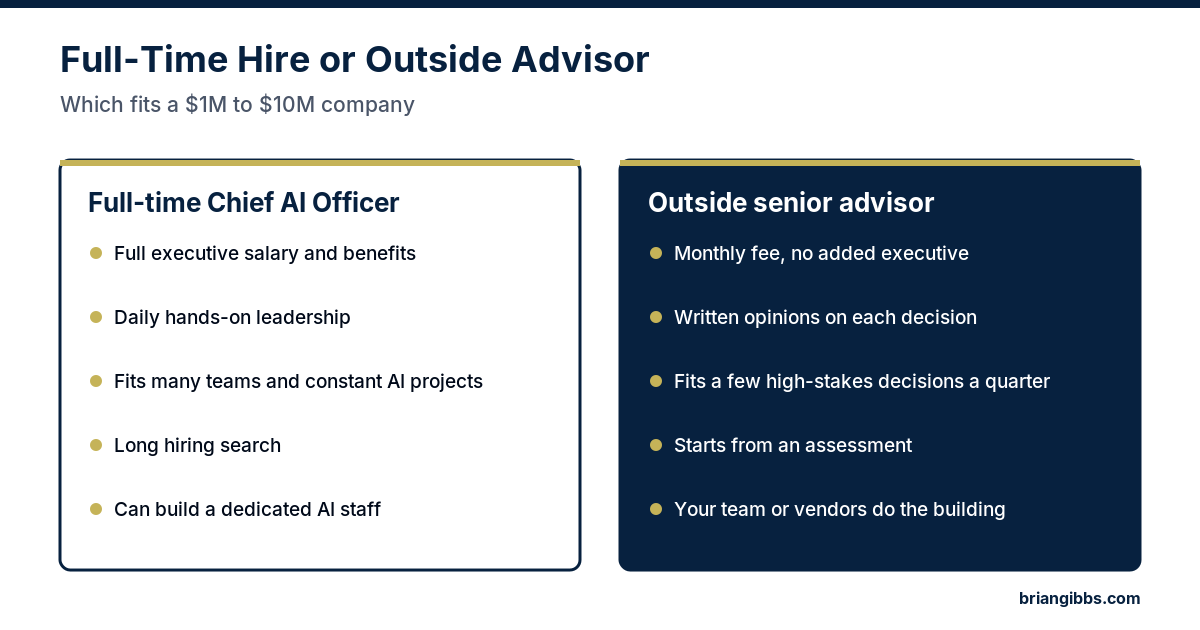
A full-time Chief AI Officer fits a company where AI decisions happen every day across many teams. Common signs include several departments running AI projects at once, AI built into the product the company sells, large amounts of regulated data, and a budget for a dedicated AI staff that this person would lead.
Most companies between $1M and $10M in revenue, typically with 5 to 30 employees, don’t look like that. They face a handful of AI decisions each quarter. Each one can still be expensive to get wrong. A full executive salary and benefits is a lot to pay for a few decisions a quarter, and a long hiring search delays every one of them.
The Options Owners Actually Have
When an owner decides against a full-time hire, AI leadership usually falls into one of four places.
- Nobody owns it. Tools get bought one at a time, and results go unmeasured. This is the most common setup and the most expensive over time.
- The most tech-savvy employee owns it. That person often knows the tools well and lacks the authority to change how the company works.
- A vendor owns it. The vendor’s advice tends to lead back to the vendor’s product, which is a conflict the owner should see clearly.
- An outside senior advisor owns the judgment. The advisor reviews decisions, puts opinions in writing, and leaves the final call with the owner. The company’s team or vendors do the building.
A Quick Test for an AI Leadership Gap
Answer these six questions honestly. Two or more “no” answers usually mean the company has an AI leadership gap, whatever its size.
- Can the company name its top three AI priorities and the dollar value of each one?
- Does every AI tool the company pays for have a named owner?
- Does every pilot have a written red line and a kill date?
- Has someone written down which decisions should never be handed to AI?
- Do vendor proposals get an independent review before anyone signs?
- Is there a record of past AI decisions and how they turned out?
The free Make AI Earn Its Place scorecard is a good place to start on the first question. It helps a leader name the problems that cost the company money and put a dollar figure on each one.
What to Look for in Outside AI Leadership
Titles in this field are loose, so judge outside help by how the work gets done. Five standards separate real AI leadership from a sales pitch.
- Independence. The advisor doesn’t sell software, and any relationship with a vendor is disclosed in writing.
- Written opinions. Each proposal comes back with a recommendation and the reasons for it, before anyone signs.
- A starting assessment. The advice is built on a clear picture of how work moves through the company and where it stalls.
- Clear authority lines. The advisor gives a recommendation, and leadership keeps the final say on every decision.
- A record. Every decision, the advice behind it, and the result stays with the company.
Project-based outside help works differently. A project firm usually scopes one piece of work, delivers it, and leaves. That can be the right choice for a single build. It leaves the next decision, and the one after that, back on the owner’s desk.
How Brian Gibbs & Associates Handles AI Leadership
Brian Gibbs & Associates offers three engagements, and each one stands on its own. All three begin from the same written assessment.
- AI Strategic Opportunity Map, $1,500. A written assessment that ranks the company’s AI opportunities by value, effort, and risk. It starts with a questionnaire, needs no meeting, and arrives within five business days after Brian receives the completed questionnaire.
- Private Executive AI Strategy, $7,500 by application. Brian interviews the company’s leaders and key employees and works with the leadership team until they agree on their AI priorities. The Map is included.
- Ongoing AI advisory. For companies that face AI decisions month after month, Brian also works with leadership on an ongoing basis, built on the findings of an AI assessment. He reviews vendor proposals and pilot plans before anyone signs, gives each one a written opinion with a red line and a kill date, and keeps a running record of every decision. The owner keeps the final say. See all advisory options for current terms.
None of the three includes building, installing, or managing AI tools. Brian is tool-agnostic and does not sell software. He has been building online since 1998 and working hands-on with AI since December 2022. Read more about Brian, or see what an AI strategy advisor does for a closer look at the role.
Start with the free scorecard. When the company is ready for a written answer, get the Map.
Frequently Asked Questions
What does a Chief AI Officer do?
A Chief AI Officer decides where AI belongs in the company, sets which decisions stay with people, reviews AI proposals before money is spent, sets a red line and a kill date for each project, and keeps a record of decisions and results.
Does a $1M to $10M company need a full-time Chief AI Officer?
Usually not. A full-time hire fits companies with AI projects running across many teams every day. Companies in the $1M to $10M range usually face a handful of high-stakes AI decisions each quarter, which outside senior advice can cover for far less than a full executive salary.
Who should own AI decisions in a mid-sized company?
The owner or CEO should keep the final say. Day-to-day ownership of each AI tool or pilot should sit with one named person who has the authority to change how the work gets done. An outside advisor can review the decisions and put recommendations in writing.
How is outside AI leadership different from hiring a project firm?
A project firm usually delivers one defined piece of work and then leaves. Outside AI leadership stays with the company over time, reviews each new decision before money is spent, and keeps a record of what was advised and what was chosen.
Does Brian Gibbs & Associates offer ongoing AI advisory?
Yes. Ongoing advisory is built on an AI assessment of the company. Brian reviews AI proposals and pilot plans before anyone signs, gives written opinions, and keeps a decision record. It is advisory only, and the company’s own team or its vendors do the building. Current terms are on the advisory page.