

AI in Marketing: What to Automate and What to Keep Human
AI made marketing content cheap to produce. That means every competitor can now publish more posts, emails, and ads than ever, and most of it reads the same. Buyers notice. Generic content gets skimmed, ignored, or quietly counted against the company that sent it.
The companies getting real value from AI in marketing use it for the repeat drafting and keep people in charge of the message, the offer, and the final sign-off. This guide shows owners and CEOs where that line sits, how to write prompts that produce usable drafts, how to get more out of content they already own, and how to check quality before anything goes out.
The Channel Changes. The Principle Stays.
I started building websites in 1998. One of my early projects was my father’s roofing company. My father was spending about $10,000 a year on phone book ads and asked me what I thought. I told him to take a quarter of that budget and put it into Google Ads, where people were already searching for roofers. We never even spent the full $2,500, and new customers still came in.
The lesson I took from that project still applies to AI. Put the marketing budget where the buyers are, measure what it produces, and move money away from what doesn’t perform. AI is a faster way to produce and test marketing. It still needs someone to decide what the company is saying and to whom.
Where AI Helps in Marketing
- First drafts. Blog outlines, social posts, email newsletters, and product descriptions. A draft in minutes gives the team something to edit.
- Versions for each channel. One article can become a newsletter, several social posts, and a short script for video.
- Lead follow-up. Drafted replies and follow-up sequences, based on the company’s own past answers, reviewed by a person before sending.
- Ad testing. Several headline and description options for each ad, so the team can test more ideas with the same budget.
- Customer feedback. Summaries of reviews, survey answers, and support emails that show what customers praise and what they complain about.
- Reporting. A plain-language summary of the month’s marketing numbers for the leadership meeting.
What People Keep
Some marketing decisions carry too much weight to hand to a tool. Positioning and the offer stay with leadership. So do prices, warranties, and any claim a customer or regulator could hold the company to. Customer stories and testimonials must be real and approved by the customer. Brand voice and final edits belong to someone who knows the company. Nothing goes out without a named person signing off.

The principle I use applies here as well. AI gets authority deliberately. Human judgment stays where consequences matter.
A Prompt Formula That Produces Usable Drafts
Most weak AI output comes from weak prompts. A vague request such as “write something for social media” gets a vague answer. A good prompt works like a short creative brief. A simple formula covers the basics.
Format + Topic + Audience + Tone
Here are three examples:
- “Give me 10 LinkedIn post ideas about scheduling problems, for owners of plumbing companies with 10 to 30 technicians. Plain, direct tone.”
- “Write three versions of a follow-up email for a customer who received an estimate five days ago and hasn’t replied. Friendly and short. No discounts.”
- “Draft a one-month content calendar for a commercial cleaning company that wants more office building contracts. Four posts a week.”
Three habits make the formula work better:
- Plan in batches by theme. Ask for a month of posts around one theme at a time. Batching takes less time and keeps the message consistent.
- Describe the voice. Paste in two or three pieces the company is proud of and ask the tool to match them. List words to avoid.
- Fix and retry. When the output is bland, add detail about the audience, name the platform, ask for several options, or say what to leave out.
For more on setting up ChatGPT so it remembers the company’s context every time, see how leaders use ChatGPT to save time.
Get More From Content the Company Already Owns
Most established companies have years of useful material sitting unused, such as old guides, PDFs, presentations, past blog posts, and long email answers to customer questions. AI makes it fast to turn that material into fresh content.
- Pick one asset that still holds up. Choose something customers found useful and that is still accurate.
- Update the facts. Have a person check prices, dates, services, and any numbers before anything else happens.
- Ask AI for an outline of the key points. Use it to spot what is still valuable and what is out of date.
- Turn it into several formats. A blog post, a short email series, a handful of social posts, and a one-page checklist.
- Review and schedule. Run the quality check below, then spread the pieces out over several weeks.
Repurposing one strong piece is usually worth more than writing several new average ones.
Check Quality Before Anything Goes Out
Generic content costs more than it saves. It wastes the reader’s time and tells buyers the company has nothing specific to say. Every AI-assisted piece should pass five checks before it is published or sent.
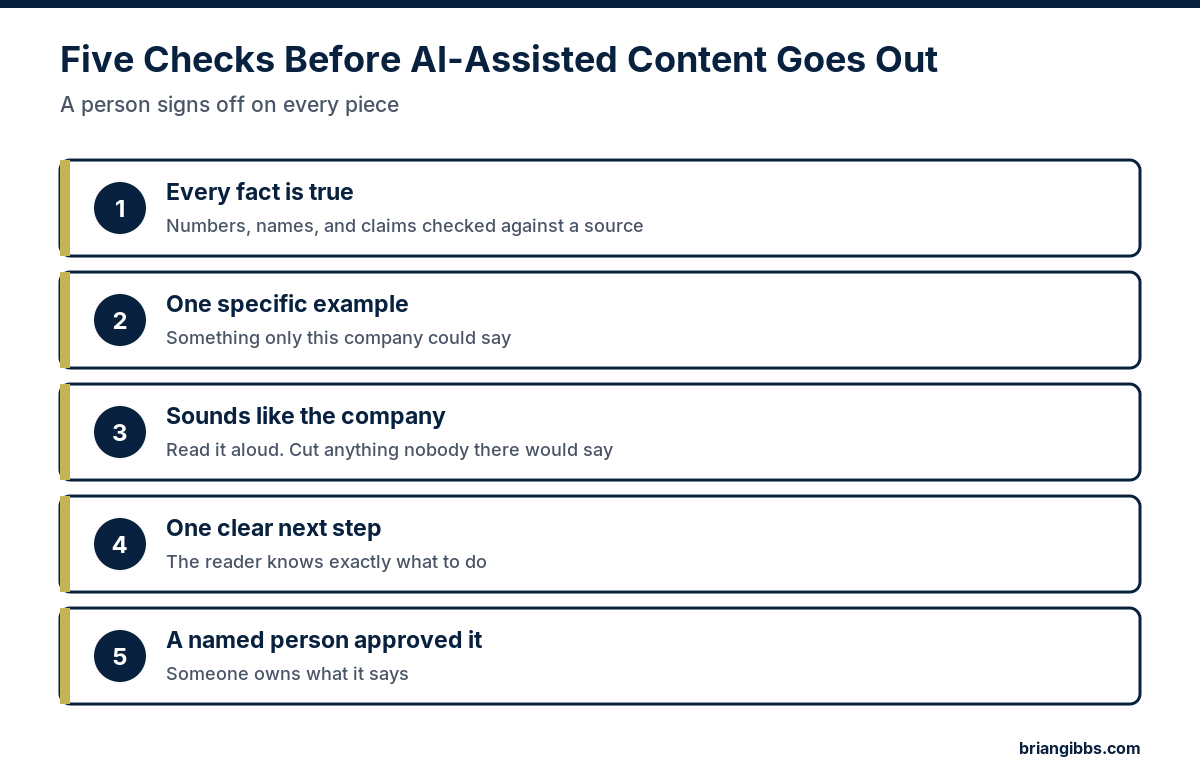
- Every fact is true. Numbers, names, and claims are checked against a real source. AI tools can state false things with total confidence.
- It includes one specific example. A detail from the company’s own work that a competitor couldn’t copy.
- It sounds like the company. Read it aloud and cut anything nobody at the company would actually say.
- It has one clear next step. The reader knows what to do after reading.
- A named person approved it. Someone at the company owns what it says.
Measure What AI Changes
Pick two or three numbers before adding AI to marketing work, and check them after 30 and 90 days. Useful numbers include hours the team spends on content each week, leads per month, time from inquiry to first reply, and cost per lead from ads. If the numbers don’t move, change the approach or stop. Producing more content only helps when it brings in more business.
The same discipline applies to the tools themselves. Before adding another marketing subscription, read why AI tools fail without a plan, which includes a five-question audit for tools the company already pays for. For first projects outside marketing, see seven AI automation tasks to start with.
Decide Where AI Belongs in the Whole Company
Marketing is often the first place a company tries AI, and it is rarely the place with the most money at stake. The free Make AI Earn Its Place scorecard helps a leader name the costly problems across the company and pick the top three.
The AI Strategic Opportunity Map from Brian Gibbs & Associates is a $1,500 written assessment that ranks a company’s AI opportunities by value, effort, and risk. It starts with a questionnaire, needs no meeting, and arrives within five business days after I receive the completed questionnaire. I am tool-agnostic and do not build, and I have been working hands-on with AI since December 2022. See all advisory options, or read more about me.
Frequently Asked Questions
What parts of marketing should a company hand to AI first?
Start with repeat drafting work, such as first drafts of posts and emails, versions of one piece for each channel, lead follow-up messages, and ad headline variations. A person reviews and approves everything before it goes out.
Will AI replace a marketing team?
In most established companies, AI speeds up drafting and testing while people keep positioning, the offer, customer stories, brand voice, and sign-off. The team spends less time on first drafts and more time on judgment.
How can a company keep AI content from sounding generic?
Give the tool a clear brief using format, topic, audience, and tone. Paste in examples of the company’s best work. Then require one specific example in every piece and have a person read it aloud before approving it.
Can AI turn old PDFs and blog posts into new content?
Yes. Pick an asset that still holds up, have a person update the facts, ask AI for an outline of the key points, then turn it into a blog post, an email series, social posts, and a checklist. Review each piece before scheduling it.
How should a company measure AI in marketing?
Record two or three numbers before starting, such as hours spent on content, leads per month, time to first reply, and cost per lead. Check them at 30 and 90 days. Keep what moves the numbers and drop what doesn’t.